Self-Service Hardware Trends in Restaurants & Retail for 2026
By MHY Engineering Team · Updated · 8 min read
Kiosk RFQs from restaurant and retail chains in 2026 look noticeably different from three years ago — not because the core hardware changed dramatically, but because buyers are now specifying for a fleet, not a single unit. Four trends show up consistently across the requests we see: a more selective approach to cash, loyalty program integration baked in from day one, a shift toward curved and compact form factors in tight counter spaces, and remote fleet management as a default requirement rather than an add-on. This piece walks through each and what it means for your next RFQ; pair it with our core buying guide if you're specifying from scratch.
1. Cash acceptance is narrowing, not disappearing
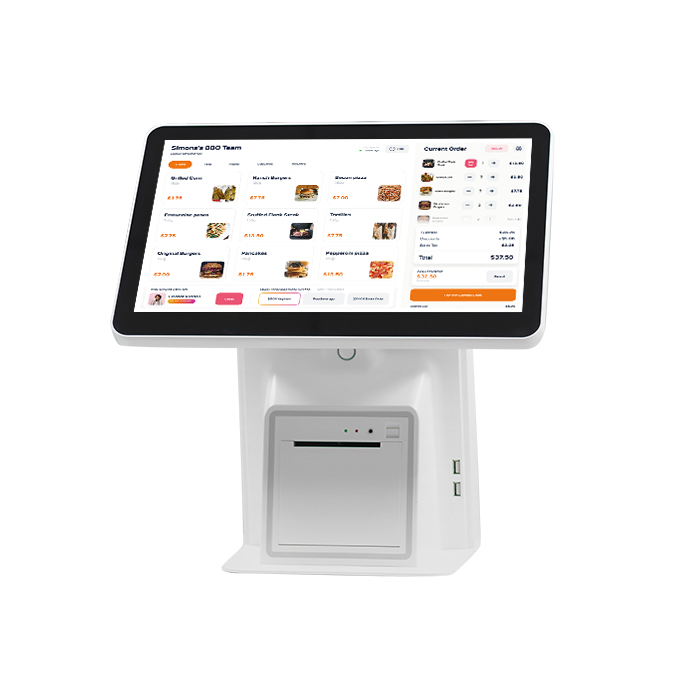
The narrative that kiosks are going fully cashless is only half true. Card and QR payment dominate transaction volume almost everywhere, but most chains have learned that removing cash entirely turns away a real share of customers and, in some jurisdictions, raises accessibility questions for unattended terminals. What's actually happening is concentration: instead of equipping every kiosk with a banknote acceptor, chains put a cash recycling payment kiosk at one or two stations per location and keep the rest card/QR-only, cutting hardware cost while preserving a cash option for the customers who need it.
2. Loyalty and membership integration
Loyalty program integration — scan a member code, tap a phone, look up by phone number at checkout — has moved from a nice-to-have to a default line item in RFQs. The good news for hardware specification is that it requires almost nothing new: most kiosks already ship with a QR/barcode scanner and NFC reader for payment purposes, and loyalty lookup reuses the same modules. The real work is on the software integration side (confirming the scanner supports the code formats and NFC modes the loyalty platform expects), not the hardware bill of materials.
3. Curved and compact-body screens
Compact, curved-body kiosks like our Curved Compact Self-Service Kiosk are showing up more often in RFQs for tight QSR counter spaces, for two reasons: they occupy less floor footprint than a flat-panel tower, and the curved presentation gives a more distinctive, ergonomic feel than a generic rectangular screen. This is a design and space-efficiency trend, not a functional necessity — flat-panel kiosks remain the right default wherever floor space isn't the binding constraint.
4. Remote fleet management
Chains deploying more than a handful of kiosks increasingly specify remote fleet management as a baseline requirement: uptime monitoring, remote app and content pushes, and remote diagnostics/restart from a central dashboard, without dispatching a technician to every store. This is primarily a software and OS specification (confirm your Android or Windows build supports the management agent your integrator uses) rather than a change to the physical kiosk, but it needs to be scoped at RFQ stage since retrofitting fleet management onto already-deployed units is more disruptive than building it in from the first order.
5. What's landing in RFQs this year
| Trend | Hardware impact | Typical scope |
|---|---|---|
| Selective cash acceptance | Banknote acceptor/recycler on select units | 1-2 kiosks per location, rest card/QR-only |
| Loyalty integration | None — reuses existing QR/NFC modules | Software integration, all units |
| Curved/compact screens | Chassis choice, comparable cost at volume | Space-constrained counters |
| Remote fleet management | None — OS-level management agent | Specify at RFQ stage, all units |
6. Frequently asked questions
Is cash acceptance still worth specifying on new self-order kiosks in 2026?
What does loyalty integration actually require from the kiosk hardware?
Why are curved-screen kiosks becoming more common?
What does remote fleet management add to a kiosk deployment?
Are these trends adding meaningful cost to kiosk RFQs in 2026?
Speccing your next kiosk order around these trends?
Tell us your fleet size and which of these matter for your rollout — we'll recommend the right module mix and quote it.