Kiosk Certification FAQ: CE, FCC, RoHS and ISO 9001 for Importers
By MHY Engineering Team · Updated · 7 min read
Certification marks on a kiosk spec sheet are easy to skim past, but they carry real legal weight — the wrong assumption about which marks are mandatory, or accepting a certificate without checking what it actually covers, is one of the most common ways an import shipment gets held up or a product gets pulled from a market. This FAQ answers the questions buyers ask most often when reviewing a kiosk manufacturer's certification claims. For the country-by-country logistics of a multi-market rollout, see our compliance checklist.
1. What CE marking actually means
CE marking is a legal requirement, not an optional quality badge, for placing electronic equipment on the market in the European Economic Area. It is the manufacturer's own declaration that the product meets the applicable EU directives — typically the Low Voltage Directive, the EMC Directive, and the Radio Equipment Directive for anything with Wi-Fi or Bluetooth — backed by test reports from an accredited lab. Crucially, CE marking is self-declared: there is no government body stamping approval before sale, which means the mark is only as trustworthy as the test documentation standing behind it. Always ask for the actual Declaration of Conformity and test reports, not just confirmation that "it's CE certified."
2. FCC certification for the US market
FCC certification is the US equivalent for electronic devices, though narrower in scope — it focuses primarily on electromagnetic emissions and interference rather than the broader safety and radio-equipment scope CE covers. Devices with intentional radiators (Wi-Fi, Bluetooth, cellular modules) require FCC ID grant listings, searchable in the FCC's public database, which is a useful way to independently verify a manufacturer's claim rather than taking a spec sheet at face value.
3. RoHS: restricted substances, not performance
RoHS (Restriction of Hazardous Substances) restricts the use of substances like lead, mercury and certain flame retardants in electronic components — it is a materials-compliance standard, unrelated to the kiosk's electrical safety or performance. RoHS compliance is generally handled at the component level by reputable electronics suppliers, but it's still worth confirming with your manufacturer, particularly for any custom-molded plastic enclosure parts or cabling sourced outside their standard supply chain.
4. ISO 9001: factory, not product
ISO 9001 certifies a factory's quality management system — documented processes for design control, incoming inspection, production consistency and corrective action — not any individual product. It's a meaningful signal that a manufacturer has disciplined, repeatable processes (and is frequently required in B2B tender documentation), but it does not substitute for product-level certification like CE or FCC, which apply to the specific device being shipped, not the factory that built it.
5. Documents to request from a factory
- ✓ CE Declaration of Conformity — lists the specific directives and harmonized standards tested against.
- ✓ Accredited lab test reports — the underlying EMC/safety data behind the CE declaration, not just the summary certificate.
- ✓ FCC grant listing — if shipping to the US, searchable independently in the FCC database.
- ✓ RoHS compliance statement — confirming restricted-substance limits are met.
- ✓ ISO 9001 certificate — confirms factory-level process discipline, with a real issuing body and expiry date.
- ✓ PCI PTS listing — for the payment module specifically, if the kiosk accepts card payments.
6. How OEM customization affects certification
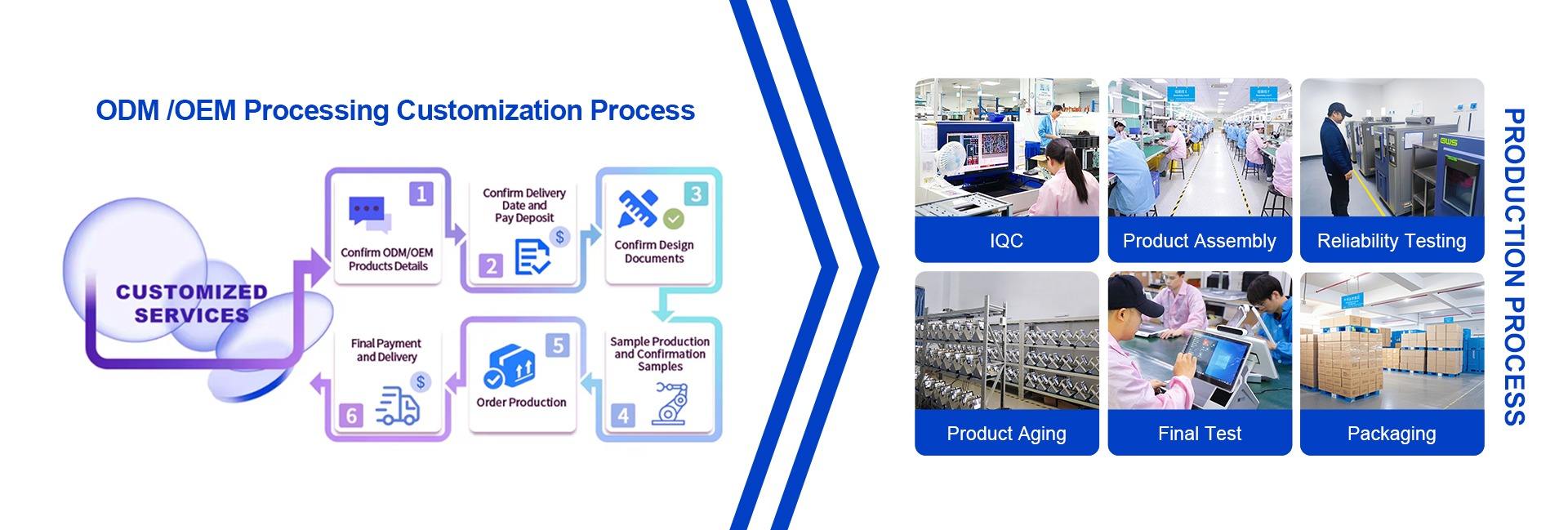
Cosmetic customization — your logo on the bezel, a custom paint color, a branded boot screen — does not affect a kiosk's existing certification, since none of it touches the electrical or radio characteristics being tested. But customization that changes internal hardware is different: swapping the power supply, adding a wireless module, or changing the payment reader can invalidate the original test reports for that configuration, since the certified product and the shipped product are no longer identical. Always disclose planned hardware-level customization to your manufacturer before ordering — reputable OEM/ODM partners will tell you upfront whether re-testing is needed, which is far cheaper to resolve during quoting than after a shipment is already held at customs. See our OEM vs ODM guide for how customization depth generally maps to lead time and cost.
7. Frequently asked questions
Is CE marking mandatory to import kiosks into the EU?
What is the difference between FCC and CE?
Is ISO 9001 a product certification?
What documents should I request from a kiosk manufacturer before ordering?
Does customizing a kiosk (OEM branding, added modules) affect its certification?
Need to verify a specific certification before ordering?
Send us your target market and we'll confirm exactly which marks apply and share the underlying test documentation.