Self-Order Kiosk Buying Guide for Multi-Site QSR Chains
By MHY Engineering Team · Updated · 12 min read
Specifying a single kiosk for one restaurant is a hardware decision. Specifying kiosks for a chain rolling out across multiple countries is a hardware and logistics decision — the screen and chassis need to work the same way in every store, while payment methods, power infrastructure, language and certification requirements all differ by market. Get the split wrong and you end up with a warehouse of incompatible SKUs, or a single design that fails compliance in half your target countries. This guide walks through how established QSR and retail chains structure a multi-market kiosk rollout. Start with our single-site buying guide first if you haven't already — this guide assumes you've settled the core spec and are now scaling it.
1. Why chains standardize on one hardware baseline
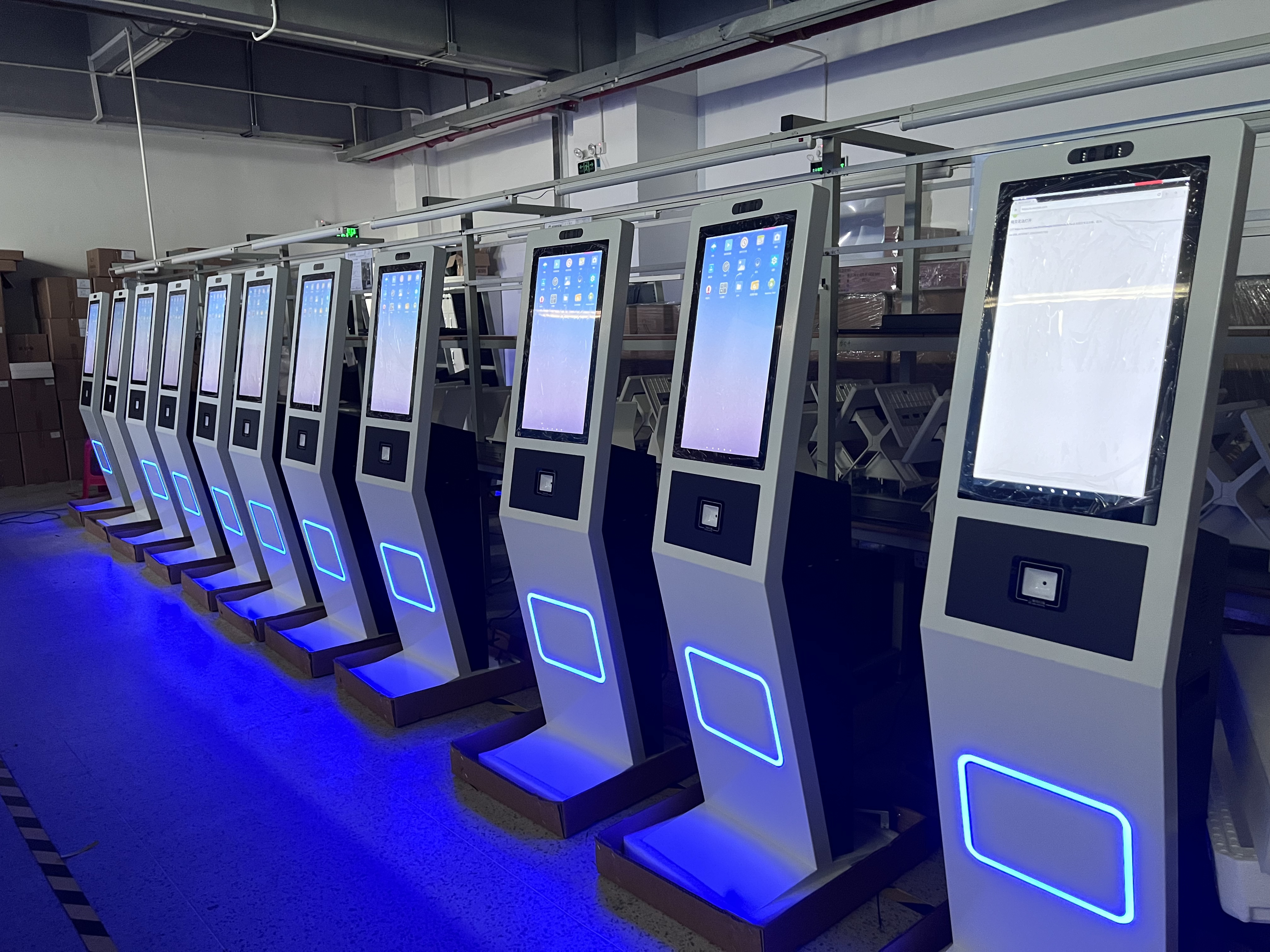
The chains that scale kiosk deployments smoothly almost always converge on one core hardware SKU — same screen size, same chassis, same mainboard and OS image — and vary only the parts that legally or functionally must differ by market: the payment terminal module, the power supply, and the regulatory compliance label. This matters for three practical reasons. Spare parts and repair training stay interchangeable across every store, regardless of country. Store operations and field technicians only ever learn one physical machine. And software — the self-order app, remote monitoring, fleet management — targets one hardware profile instead of maintaining branches for regional variants. A second SKU (typically a smaller desktop unit for compact-footprint stores) is common, but chains that go beyond two SKUs usually find the added inventory complexity isn't worth the marginal fit improvement.
2. Handling regional payment methods
Payment is the single most variable component across markets. A kiosk destined for Western Europe needs EMV contact and contactless card acceptance; one for Singapore or Southeast Asia often needs to add PayNow or local QR wallet support; one for China typically routes through UnionPay and WeChat/Alipay QR. Rather than designing a bespoke payment stack per country, most chains maintain a short library of 2-3 pre-qualified payment modules (see our payment & POS terminal line) and assign the appropriate one to each market during final configuration, keeping the rest of the kiosk identical. Confirm each module is independently certified for the payment schemes it will process in that specific country — a certification obtained for one market's card networks doesn't automatically extend to another's.
3. Power, plugs and voltage across markets
Input voltage, frequency and plug type vary by region — this is a solved problem (see our multi-country compliance checklist for the full voltage/plug reference), but it needs to be specified explicitly per shipment rather than assumed. Most kiosk power supplies are universal-input (100-240V, 50/60Hz) as standard, so the variable is almost always the power cord and plug adapter, not the internal power supply itself — confirm this with your factory in writing rather than assuming universal input, since some lower-cost configurations use fixed-voltage supplies to shave cost.
4. Language, currency and menu localization
Screen size, resolution and OS platform (Android or Windows) should stay identical across markets — changing these per country is the most common unnecessary source of cost and complexity in a multi-market rollout. What legitimately changes market to market is entirely software-side: the app's language pack, currency formatting and decimal conventions, local menu content and pricing, and any region-specific promotional or loyalty integration. Keeping this split clean — hardware identical, app layer localized — is what lets a chain add a new market by shipping a language pack rather than requalifying a new machine.
5. Certification market by market
| Market | Core marks typically required | Payment-specific step |
|---|---|---|
| European Union / EEA | CE, RoHS | Payment module PCI/EMV certification for the region |
| United States / Canada | FCC (US), IC (Canada) | PCI PTS certification for the payment terminal |
| China | CCC (where applicable), local telecom approvals | UnionPay / local wallet certification |
| Most other markets | Often accept CE/FCC as reference marks | Confirm locally — varies by country |
Core hardware certification (CE, FCC, RoHS) generally transfers across many markets once obtained, but payment-scheme certification does not — it has to be arranged per scheme, sometimes per country, and is typically the buyer's or local integrator's responsibility rather than the hardware factory's. Our certification FAQ covers what documentation to request from a manufacturer before your first market launch.
6. Rollout logistics: pilot, phase, scale
Pilot market
Qualify the hardware baseline and one payment module in a single market first — surface issues before they multiply.
Add payment modules
Qualify additional payment modules for each new region as it's added, reusing the same core hardware.
Localize software
Ship language and currency packs per market without touching the hardware spec.
Phase the fleet order
Order in phases tied to store-opening schedule rather than one bulk order, to smooth lead time and cash flow.
Centralize spares
Stock spare parts centrally per region since the hardware baseline is shared across every store.
Fleet monitoring
Roll out remote monitoring/management across all markets on day one, not retrofitted later.
7. Baseline vs per-market decisions at a glance
| Element | Keep standardized | Localize per market |
|---|---|---|
| Screen, chassis, mainboard | ✔ Same everywhere | |
| OS platform | ✔ Same everywhere | |
| Payment module | ✔ Per region's schemes | |
| Power cord / plug | ✔ Per country | |
| App language & currency | ✔ Per market | |
| Regulatory label | ✔ Per region's marks |
8. Frequently asked questions
Should a multi-country QSR chain use one kiosk hardware SKU everywhere?
How do we handle different payment schemes across markets in one rollout?
Does the screen or OS need to change between markets?
How much lead time should a multi-country rollout add versus a single-market order?
Who is responsible for in-country certification when rolling out to a new market?
Rolling out kiosks across several markets?
Tell us your target countries and store count — we'll recommend a hardware baseline and payment-module library, and quote a phased rollout.