How to Source Kiosks from China: A Factory Due Diligence Checklist for B2B Buyers
By MHY Engineering Team · Updated · 11 min read
Most kiosk sourcing problems don't show up in the quotation — they show up three months later, when the "factory" you ordered from turns out to be a trading company that subcontracted your order to whichever shop had capacity that week, the CE mark on the box doesn't match the actual model shipped, or the full balance was wired before anyone outside the supplier's own staff had laid eyes on a finished unit. None of this requires exotic due diligence to catch. It requires a checklist, applied before the deposit goes out, not after. This guide walks through the five checks that catch the large majority of sourcing problems, in the order we'd actually run them.
1. Verify you're talking to a factory, not a reseller
The single most consequential fact to establish early is whether you're dealing with the actual manufacturer or an intermediary reselling someone else's production capacity. Neither is inherently dishonest — plenty of legitimate trading companies add real value in language, logistics and quality control — but you need to know which one you're negotiating with, because pricing, lead time control and accountability for defects all depend on it.
Start with the business license (营业执照). Every legally operating company in China has one, and a legitimate supplier will share a copy without hesitation. The registered business scope (经营范围) on the license will state whether the company is licensed for manufacturing or only for trading/import-export — this single field settles most of the ambiguity. Cross-check the company name on the license against the name on any quotation, certificate or export document you've been sent; a mismatch is the most common way a trading company's role gets obscured.
The second check is a live video call, camera on, walking the production floor — not a pre-recorded factory tour video, which can (and often does) belong to a different facility entirely. Ask to see the SMT line, final assembly, and the finished-goods warehouse in the same call, and ask questions that require the person to be physically present and knowledgeable, like "how many kiosks came off this line today" or "what's this specific tooling fixture for." A real factory representative answers these naturally; someone reselling capacity they don't control usually can't.
2. Request a factory audit — video or third-party
A live video audit, as described above, is a reasonable first filter for most orders and costs nothing but time. For a first-time supplier relationship above roughly $30,000-$50,000, or for any order where a defect would be expensive to remediate after shipping (a multi-country rollout, a branded run with custom tooling), it's worth paying for an independent third-party inspection — SGS, Bureau Veritas, TÜV Rheinland, or a reputable local agency all offer factory audits and pre-shipment inspections in the Shenzhen/Guangdong region, typically for a few hundred US dollars.
A third-party audit report covers things a video call can't fully verify: whether the factory's actual production capacity matches what it claims, whether working conditions and basic compliance items are in order, and — critically for a pre-shipment inspection — a statistical sample check of the finished goods against your agreed specification before the balance payment is released. This is the single highest-leverage step for orders large enough that a defect rate you didn't catch would be expensive.
3. Check that certifications actually cover your product
A certificate is only meaningful if it covers the specific model you're ordering, and the fastest way to a costly customs or compliance problem is assuming a CE or FCC mark applies to your unit because the supplier's catalog shows it somewhere. Ask for the underlying test report, not just the certificate — the report lists the exact model number tested, the standards it was tested against, and the lab that issued it. Confirm that model number matches what's on your purchase order, including any OEM/ODM changes; a chassis redesign, a different touchscreen module, or an added peripheral can require re-testing depending on what changed.
For FCC, verification is straightforward: every authorized device has an FCC ID that can be looked up directly on the FCC's public equipment authorization database, which will show the grantee, the test lab, and the exhibits filed. For CE, ask which notified body or accredited test lab issued the report, and check that the lab appears on the relevant national accreditation registry (such as UKAS in the UK or the equivalent in your import market) — CE marking for most product categories is a self-declaration backed by a genuine test report, so the report's origin is what to scrutinize. Our own certification FAQ covers which marks are mandatory in which markets and what documentation to request.
4. Order a sample before committing to the MOQ
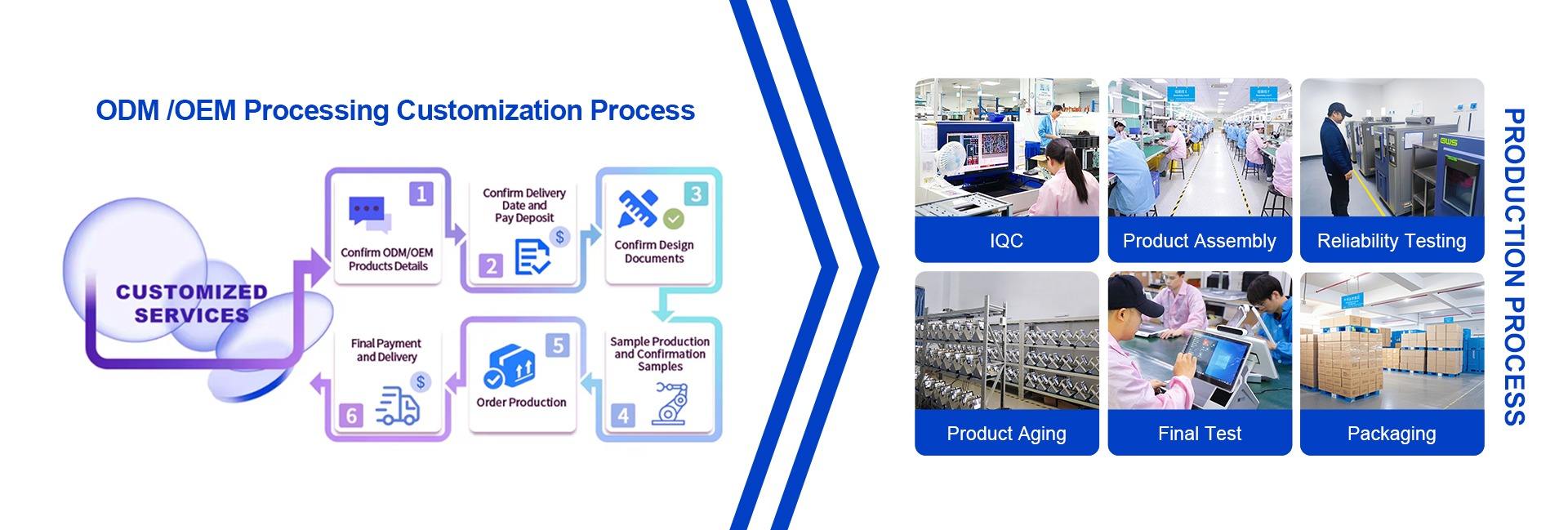
For any first order, and for any order involving OEM/ODM changes from a factory's standard configuration, a pre-production sample isn't optional — it's the only point in the process where you can verify build quality, fit and finish, screen calibration, and software behavior before the number of units in production makes a defect expensive to fix. A sample also surfaces communication gaps early: if the sample doesn't match the agreed spec, better to find out on one unit than on five hundred.
Most reputable factories, MHY included, will credit some or all of the sample cost against the bulk order once it's confirmed, which means the cost is rarely wasted even in the (uncommon) case that you decide to source elsewhere. Treat any supplier who refuses to provide a paid sample, or who insists the MOQ must be committed before any physical unit is produced, as a meaningful red flag rather than a minor inconvenience.
5. Structure payment terms to protect both sides
The most common structure for kiosk orders in the low-to-mid five figures is a 30% deposit by wire transfer (T/T) to start production, with the remaining 70% paid once a pre-shipment inspection report (or, at minimum, detailed photos and video of the finished, packed goods) confirms the order matches specification — the balance is paid before goods are released for shipping, but after you've had an independent checkpoint. This gives the factory working capital to run production while giving you a verification step before the full amount is committed.
For larger orders, a letter of credit (L/C) shifts more of the payment risk to the issuing bank, which only releases funds against the exact shipping documents specified in the L/C terms — it adds paperwork, lead time and bank fees, so it's usually only worth the overhead above roughly the low six figures. Whatever structure you use, avoid paying 100% upfront regardless of order size or how good the price looks; it removes every incentive for a supplier to resolve issues that surface during production.
6. Red flags to walk away from
| Signal | Why it matters |
|---|---|
| Refuses a live video walkthrough of the production floor | Strong indicator of a trading company without direct production control |
| Certificates don't list a model number matching your order | The certification may not legally cover the unit you'd receive |
| Insists on 100% payment upfront, no exceptions | Removes your leverage if the order doesn't match spec |
| Refuses to provide a paid sample before the MOQ | No way to verify quality before production volume is committed |
| Pricing is dramatically below every other quote for the same spec | Usually means a cut corner — cheaper components, no real QC, or a bait-and-switch on final spec |
7. Frequently asked questions
How can I tell if a supplier is a real factory or a trading company?
Is a video factory audit good enough, or do I need an in-person or third-party audit?
How do I verify a certification like CE or FCC is genuine and actually covers my product?
Should I always order a sample before committing to the full MOQ?
What payment terms protect a first-time buyer without over-burdening the factory?
Want to see our factory before you order?
We'll walk you through our production line on a live video call, share our business license and certification test reports, and quote a sample run — no pressure to commit to an MOQ first.