Kiosk Payment Integration: EMV, NFC and PCI Compliance for OEM Hardware
By MHY Engineering Team · Updated · 10 min read
Payment integration is the part of a kiosk project most likely to blow a launch date, not because the hardware is exotic, but because it sits at the intersection of three parties who rarely talk to each other early enough: the kiosk manufacturer, the payment gateway or processor, and the acquiring bank. Get the sequencing wrong — pick hardware before confirming the gateway, say — and you can end up with a reader that has to be re-certified after units are already built. This guide lays out what to specify, who's responsible for what, and where the integration timeline actually goes long.
1. Which payment methods a modern kiosk needs
For most retail, QSR and self-checkout deployments in 2026, the practical baseline is: EMV chip insert, NFC/contactless tap (which covers physical contactless cards and mobile wallets like Apple Pay and Google Pay on the same antenna), and QR-code scan-to-pay for region-specific wallets like WeChat Pay and Alipay. Magnetic stripe is increasingly optional outside a handful of markets where it's still common, and cash — where specified at all — is usually concentrated on one or two units per location rather than built into every kiosk, a shift we cover in more detail in our 2026 hardware trends piece.
2. EMV card readers and certification
Commercial kiosk EMV readers are almost always combo modules — chip insert, contactless tap and (where still needed) magstripe in a single certified unit — because certifying separate readers for each payment type rarely makes economic sense. The specification question that actually matters is which specific reader model you're getting and which processors and acquiring networks it's already certified against, not whether it "supports EMV" in the abstract. A reader can be fully EMV Level 1/2 certified in general and still not be certified for the specific gateway or acquirer you plan to use, which is the gap that causes the most integration delays.
3. NFC, mobile wallets and QR payments
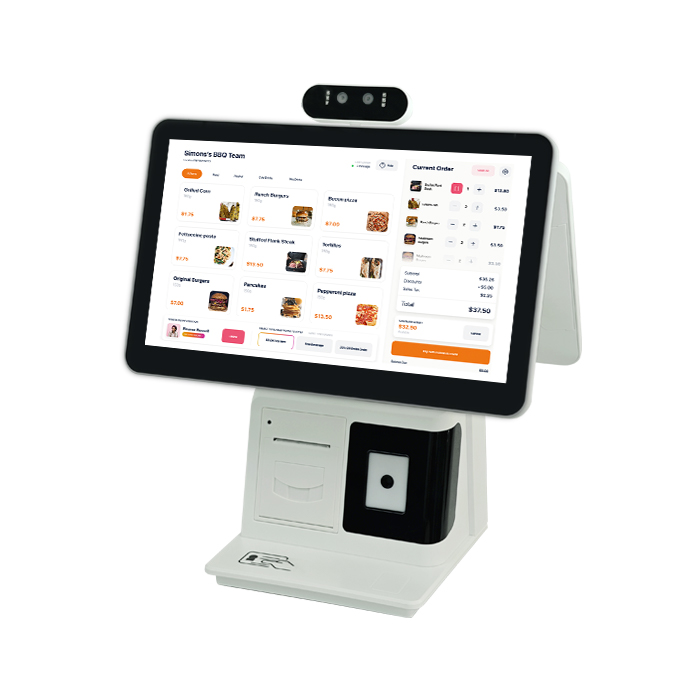
NFC/contactless is a single antenna serving multiple payment rails at once: a physical contactless card, Apple Pay, Google Pay and similar wallets all use the same tap interaction and the same hardware on the kiosk side, so there's no additional module needed to support mobile wallets once contactless card acceptance is specified. WeChat Pay and Alipay work differently — they're QR-code based, either the kiosk displaying a code the customer scans with their phone, or a scanner on the kiosk reading a code generated in the customer's app — and typically reuse the same barcode/QR scanner already fitted for loyalty programs, tickets or product barcodes. All of these payment rails can run on one kiosk simultaneously; the work is routing each to the correct settlement path in software, not adding hardware.
4. PCI compliance: vendor's responsibility vs yours
PCI compliance for a kiosk splits cleanly into two scopes, and confusing them is a common source of audit headaches later. The hardware vendor's responsibility is supplying a card reader that is itself PCI PTS (PIN Transaction Security) certified, and integrating it so that cardholder data is encrypted at the point of capture and never passes through the kiosk's general-purpose operating system in readable form — this is usually handled via point-to-point encryption (P2PE) between the reader and the payment processor. Your responsibility, as the merchant (or your payment processor's, if they manage this for you), is PCI DSS compliance of the surrounding environment: network segmentation between the kiosk and other systems, access controls, and how any transaction metadata is stored and handled downstream of the reader itself. A kiosk with a PCI PTS-certified reader significantly narrows your PCI DSS scope, but doesn't eliminate it.
5. Integrating a payment gateway
The fastest path to a working payment integration is choosing a reader that's already pre-certified against a mainstream gateway — Adyen, Stripe Terminal, Verifone and Ingenico all publish kiosk-oriented SDKs and maintain lists of certified reader hardware. Where the reader and gateway are already a certified pair, integration is primarily an API and UX exercise: two to six weeks is a realistic range for a competent integrator to wire up the transaction flow, handle edge cases (declined cards, timeout, partial refunds) and run a pilot batch of live transactions. Requesting a gateway or acquirer the reader hasn't been certified against before adds real time, because the reader itself may need to go through certification testing with that specific combination — this is the detail worth confirming with your kiosk vendor before hardware is finalized, not discovered afterward.
6. Common integration pitfalls
| Pitfall | Why it happens | How to avoid it |
|---|---|---|
| Reader not certified for the target gateway/acquirer | Hardware chosen before payment stack was finalized | Lock in gateway and target markets before finalizing reader model |
| PCI DSS scope larger than expected | Assuming a PTS-certified reader covers the whole environment | Confirm network segmentation and data handling separately from reader certification |
| QR wallet payments fail intermittently | Scanner not tuned for the specific code density/size used by that wallet app | Test with the actual wallet apps during pilot, not just a generic QR sample |
| Refund/void flow not tested before launch | Happy-path testing only covers successful payment | Include decline, timeout and refund scenarios in pilot testing |
7. Frequently asked questions
Does the kiosk manufacturer or the payment processor handle PCI compliance?
Do I need a separate reader for chip cards and for contactless/NFC payments?
Can one kiosk accept WeChat Pay, Alipay and Apple Pay alongside a card reader?
How long does payment gateway integration typically take once the hardware is chosen?
What's the most common mistake buyers make when specifying kiosk payment hardware?
Specifying payment hardware for your next kiosk order?
Tell us your target markets and payment gateway — we'll recommend a reader that's already certified for that combination and quote it.